
Latest Track:
Encore là
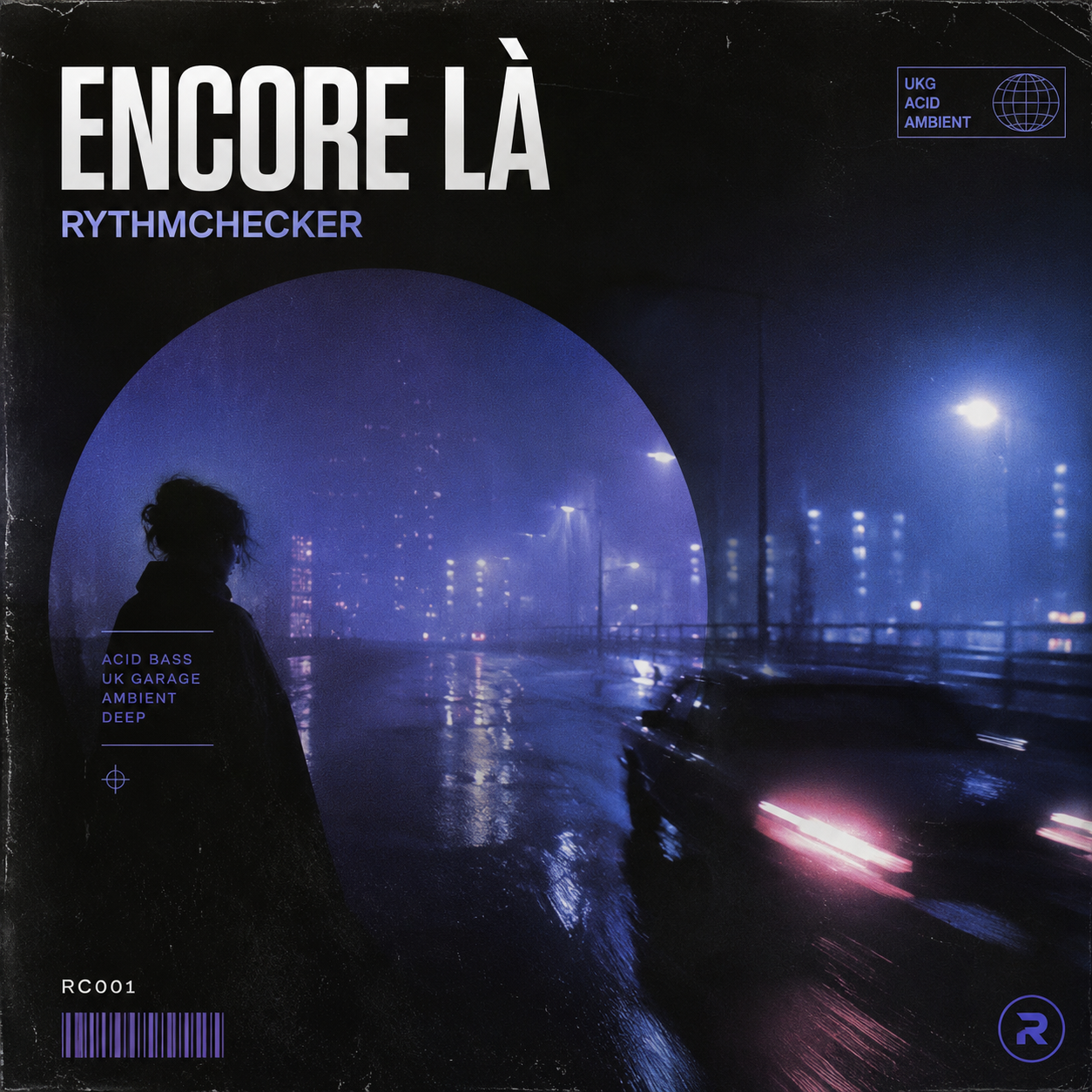
- Midnight pressure in neon light. Deep acid bass, restless UK garage rhythm and ambient haze turn a moment of drifting into a hypnotic late-night pulse.
Atmosphere
Encore là opens at midnight with neon light, drifting streets and a pulse that feels suspended between presence and escape. Deep acid bass, UK garage movement and ambient haze carry the track into a nocturnal space where the voice keeps returning: still here, almost gone.
Lyrics
Minuit
La ville coule
Et moi aussi
Sous les néons
Je dérive
Sans savoir
Sans revenir
Encore là
Encore là
Presque partie
Encore là
Laisse-moi
Dériver
Encore là
Encore là
Presque partie
Minuit
Puis rien
Story
Encore là – Still Here, Even When Everything Else Dissolves
The story behind the song – Rythmchecker
There is something strangely comforting about the words “Encore là.” Just two little French words. Still here.
Not necessarily happy. Not necessarily lost. Not even particularly certain about anything. Just here.
When I started working on this song, I wasn't interested in telling a conventional story. I didn't want another song about love, heartbreak, hope, or the usual emotional milestones we tend to turn into lyrics. I was more interested in something harder to describe: that peculiar feeling of slowly losing your sense of yourself without actually disappearing.
I think most of us experience it occasionally, although we rarely talk about it.
You might be walking through a city late at night, driving along an almost empty road, or simply sitting somewhere while the world carries on around you. Nothing particularly dramatic is happening. Yet suddenly, for a brief moment, you feel strangely detached from everything.
The familiar becomes unfamiliar. Your thoughts lose their usual importance. Even the person you believe yourself to be seems less clearly defined.
And somehow, that doesn't necessarily feel frightening.
Sometimes it feels like freedom.
When the music becomes more important than the words
Musically, I wanted Encore là to reflect precisely that state of mind.
The deep acid bass provides something physical, almost primitive. It is persistent, repetitive, and impossible to ignore. You don't just hear it; you feel it.
The broken UK garage rhythms introduce another dimension. They never quite settle into the comfortable predictability of a conventional beat. They push forward, hesitate, shift their weight, and continue.
Above all this, the lush ambient textures seem to belong to an entirely different world. They float without urgency, without direction, almost without gravity.
I liked the contradiction.
The bass keeps insisting that something is happening. The ambient sounds suggest that nothing really matters quite as much as we think.
And somewhere between those two extremes, there is a voice.
A very small voice, saying very little.
Minuit.
La ville coule.
Et moi aussi.
Midnight. The city flows. And so do I.
For me, those lines contain almost everything the song needs to say.
I deliberately kept the lyrics minimal because I didn't want words to explain what the music could express more naturally. Sometimes a long, carefully constructed lyric can actually make an idea smaller by defining it too precisely.
I wanted to leave enough space for listeners to find their own meaning.
The strange freedom of becoming less important
As we get older, we accumulate identities.
We become the person with a particular profession, a particular history, a particular set of responsibilities. We collect achievements, disappointments, opinions, habits, and expectations.
Over time, all these things begin to feel like a permanent definition of who we are.
But are they?
I sometimes wonder how much of what we call our identity is simply a collection of stories we have become accustomed to telling ourselves.
And what happens when those stories temporarily fall silent?
Perhaps that is what Encore là is really about.
Not losing yourself in a tragic sense, but discovering that you can exist without constantly explaining who you are.
The French line “Je dérive” — I drift — is important to me for that reason.
Drifting is usually presented as something negative. We are supposed to have destinations, plans, ambitions, and clearly defined objectives. We are encouraged to know where we are going, preferably with a timetable and measurable results.
But perhaps there is something valuable about occasionally moving without a destination.
About allowing yourself to exist without trying to turn every experience into progress.
About simply being part of the movement.
Almost gone, but not quite
The most intriguing phrase in the song is probably “Presque partie.”
Almost gone.
I like the ambiguity of those words.
Gone from where? From a relationship? From a familiar life? From a particular state of mind? Or perhaps simply from the constant internal conversation that normally accompanies us everywhere?
I don't think the song needs to answer that question.
To me, “Presque partie” describes the moment when the boundaries between yourself and your surroundings begin to soften.
The music becomes less like something you are listening to and more like something you are moving inside.
For a moment, there is no particular reason to analyze anything.
You are not your memories. You are not your plans. You are not even the person you were five minutes ago.
You are simply there.
And then comes the quiet contradiction at the heart of the song.
Encore là.
Still here.
The quiet resilience of simply existing
There is another side to this song, and perhaps it is the more personal one.
I have come to believe that we sometimes place far too much importance on dramatic moments of transformation.
We like stories about people who overcome enormous obstacles, reinvent themselves, discover their purpose, or emerge from difficult experiences as completely different human beings.
Those stories can be inspiring, of course.
But ordinary life rarely works that way.
More often, change happens almost invisibly.
We lose certain illusions. We abandon old ambitions. We become less certain about things we once considered obvious. People enter our lives and leave them. Places that once seemed permanent become memories.
And somewhere along the way, we change.
Not necessarily for better or worse.
Just differently.
There is a quiet kind of resilience in accepting that process without feeling obliged to celebrate or resist every stage of it.
Sometimes the most meaningful thing we can say is not “I made it,” or “I have found the answer.”
Sometimes it is simply:
I'm still here.
Not as a declaration of victory.
Not as a complaint.
Just as an observation.
And perhaps that is enough.
A small drop in an enormous universe
When I began thinking about the visual interpretation of Encore là, I imagined a world made entirely of liquid metal.
A small drop appears in darkness. It grows, changes shape, stretches into flowing structures, and eventually becomes a complicated, constantly moving universe of reflective surfaces.
Nothing remains stable.
Everything is beautiful for a moment, and then everything changes again.
Eventually, those structures dissolve into thousands of tiny particles.
The universe becomes almost empty.
And at the very end, a single small drop remains.
I find that image strangely moving.
It reminds me of how much energy we spend building structures around ourselves — careers, relationships, possessions, convictions, plans for the future — and how temporary many of those structures turn out to be.
Yet the disappearance of those structures doesn't necessarily mean the disappearance of everything that matters.
Something remains.
Maybe something smaller, simpler, and less impressive than before.
But perhaps also something more essential.
That tiny drop is my visual interpretation of Encore là.
Not a symbol of immortality or some grand philosophical truth.
Just a modest reminder that existence doesn't always need to justify itself.
Why I chose French
There is also a reason I wanted the few words in this song to be French.
For me, French has a particular ability to make even very simple expressions feel fluid and slightly mysterious.
“Encore là” sounds softer and more open-ended to my ears than its English equivalent, “Still here.”
It can suggest persistence, presence, memory, or even a faint sense of disbelief.
Still here?
Yes. Apparently.
I also liked how the language interacted with the music. The syllables could drift through the arrangement almost like another synthesizer texture, appearing briefly and then disappearing into the surrounding sound.
I didn't want a singer explaining the song to the listener.
I wanted a human presence inside an otherwise largely electronic landscape.
Something fragile among all those deep frequencies.
What Encore là means to me
In the end, I don't hear Encore là as a sad song.
There is melancholy in it, certainly. And perhaps a little loneliness.
But there is also something peaceful.
It is a song about allowing things to change without demanding that every change must lead somewhere.
About accepting that our identities are less permanent than we might like to believe.
About recognizing that even when familiar structures dissolve, life continues in quieter, less obvious forms.
The acid bass keeps moving. The broken rhythms keep finding their way forward. The ambient textures expand into the darkness.
And the voice returns, almost casually.
Encore là.
I like to imagine that somewhere, late at night, someone is listening to this song while looking out of a train window, walking through an unfamiliar city, or simply sitting alone with their thoughts.
Maybe they aren't thinking about anything in particular.
Maybe they are thinking about everything.
Perhaps, for a few minutes, the music gives them permission not to decide.
Not to explain.
Not to become someone else.
Just to drift.
And when the last sound has faded, perhaps the only thing left is that small, almost insignificant realization:
Everything changes. Everything moves. Everything eventually dissolves into something else.
And somehow, despite it all, here we are.
Encore là.