
Latest Track:
The King Of Almost Everything
– A theatrical glam-rock trip inspired by Bach's Goldberg Variations, full of roaring guitars, absurd royal imagery and a philosophical wink.
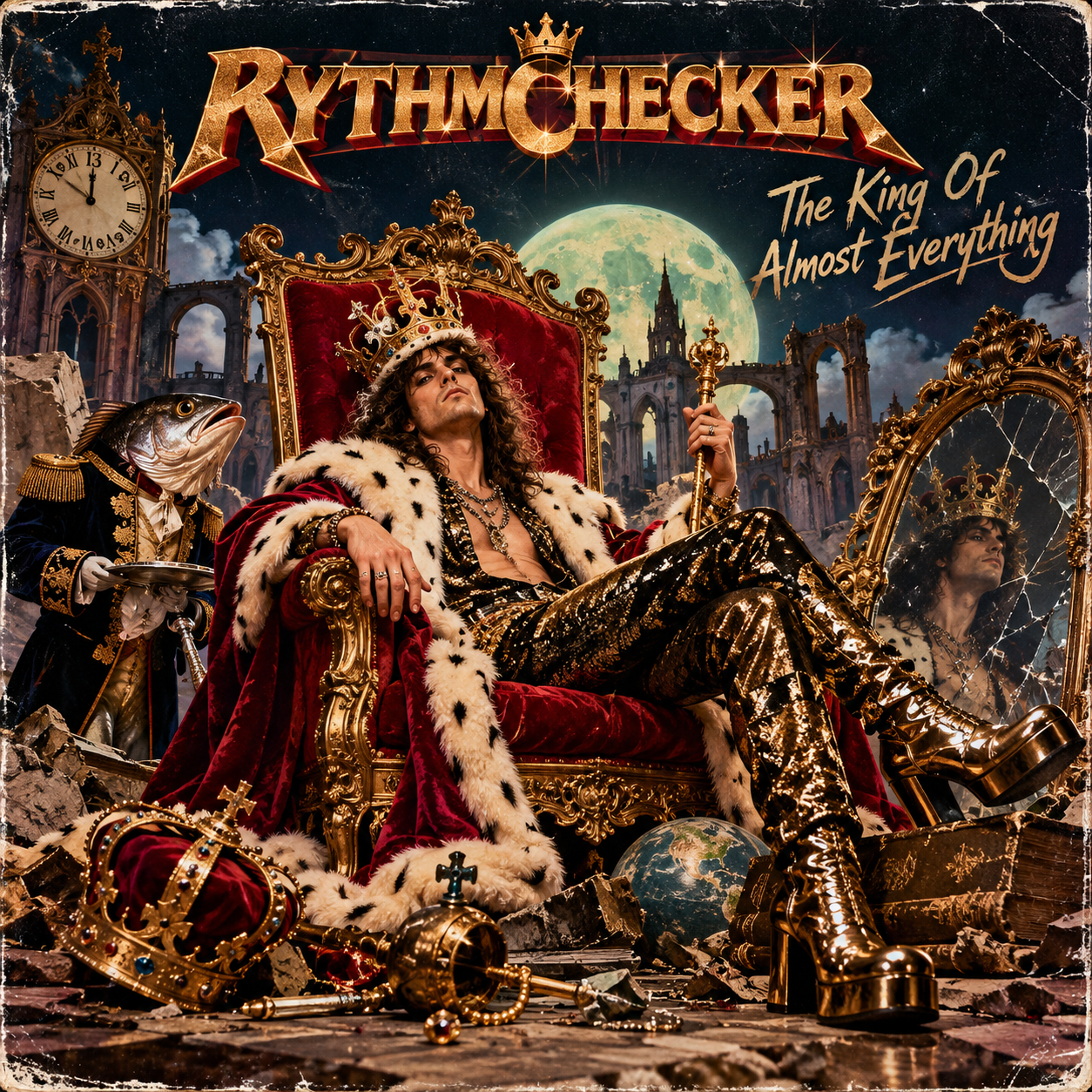
Atmosphere
Glam Rock, Bach inspiration, theatrical vocals, roaring guitars, absurd humour.
Language: English
Genre: Rock
Lyrics
I woke up wearing someone else's crown
In a city that had never been a town
The clock struck thirteen
The moon turned green
And the royal machine
Declared me king

My minister's a fish in a velvet suit
He plays the blues in crocodile boots
The queen's a mirror
The guards are blind
And somebody's stolen
The back of my mind

Oh what a beautiful disaster
Oh what a magnificent lie
They gave me a kingdom of nothing
And told me to rule till I die

I'm the king
The king of almost everything
No land no gold
No diamond ring

I'm the king
Hear the empty cathedral sing
Long live the king
Of almost everything

I signed a treaty with a paper moon
Sold my shadow to a man at noon
My jester laughed
My bishop cried
The royal accountant
Said the numbers lied

I bought a mountain
It turned to dust
I built a palace
Out of rust
I told the ocean
To learn to fly
It packed its bags
And waved goodbye

Oh what a beautiful disaster
Oh what a magnificent lie
The whole world bowed before me
But nobody could tell me why

I'm the king
The king of almost everything
No land no gold
No diamond ring

I'm the king
Hear the empty cathedral sing
Long live the king
Of almost everything

Where's my kingdom
Gone gone gone
Where's my crown
Wrong wrong wrong
Where's my future
Sold yesterday
Who gave the order
You did your majesty

Then the mirror spoke
In a voice like mine
Your majesty
You're out of time

I touched the glass
The glass touched me
And neither of us
Could find the key

I'm the king
The king of almost everything
No past no future
No golden ring

I'm the king
Hear the broken angels sing
Long live the king
Of almost everything

The crown fell down
Without a sound

Who were you
Before
The King Of Almost Everything – A Crown, a Mirror, and a Little Bit of Bach
Sometimes I wonder how seriously we should really take ourselves.
We spend so much of our lives trying to understand the world, trying to control things, trying to become somebody. We collect experiences, possessions, responsibilities, achievements, and occasionally a little recognition along the way. We build our own small kingdoms, convince ourselves that we know what we're doing, and proudly wear the invisible crowns that life hands us.
And then, every now and again, something happens that reminds us how wonderfully absurd the whole business really is.
That's more or less where "The King Of Almost Everything" began.
I wanted to write a song about a man who wakes up one morning to discover that he's become a king. Not a particularly successful king, mind you. His kingdom doesn't really exist, his minister is a fish in a velvet suit, his guards are blind, and his queen is a mirror. The clock strikes thirteen, the moon turns green, and nobody seems particularly concerned that none of this makes the slightest bit of sense.
Which, when you think about it, isn't entirely unlike the world we live in.
We surround ourselves with rules, institutions, hierarchies, and elaborate explanations for why things are the way they are. We appoint people to positions of authority, follow conventions that nobody remembers inventing, and occasionally watch the most ridiculous situations unfold with an astonishing degree of seriousness.
And somewhere in the middle of all this, we try to make sense of our own existence.
My king is certainly no exception.
He buys a mountain that turns to dust. He builds a palace out of rust. He orders the ocean to learn to fly, only to watch it pack its bags and wave goodbye. He has everything a king could possibly want, except perhaps a kingdom worth ruling.
And the funniest part is that he doesn't immediately notice.
I suppose there's a little bit of him in all of us. Certainly in me.
A Little Bit of Bach Behind the Madness
But there's another side to this song, one that reaches much further back into my own life.
Musically, "The King Of Almost Everything" follows the melody of Variation No. 4 from Johann Sebastian Bach's Goldberg Variations, BWV 988.
And that connection is particularly personal to me.
My fascination with Johann Sebastian Bach began when I was a child taking piano lessons. Long before I had any idea what kind of music I would eventually create, Bach had already found a permanent place in my musical imagination.
There was something about his music that fascinated me even then. The extraordinary precision, the independence of the voices, the way melodies seem to chase one another, cross paths, disappear and return. Everything fits together with an almost impossible sense of logic, and yet the result never feels merely mathematical.
It feels alive.
As a child, I certainly didn't understand all the musical architecture behind it. I simply knew that there was something special happening beneath my fingers.
And that fascination has never really left me.
Decades later, I still find myself returning to Bach, discovering new details in music I thought I already knew. There is an inexhaustible quality to his compositions. You can listen to the same passage a hundred times and suddenly hear something that seems to have been hiding there all along.
Variation No. 4 from the Goldberg Variations has a particularly lively, almost mischievous character. Beneath its elegant Baroque structure, I hear a rhythmic energy that seems surprisingly compatible with something much louder, rougher, and more theatrical.
So I began wondering what might happen if that musical world collided with the extravagant universe of 1970s glam rock.
What if Bach's beautifully ordered musical ideas suddenly found themselves surrounded by distorted electric guitars, pounding drums, flamboyant vocals, and a king who can't even find his own kingdom?
The contrast appealed to me immediately. And perhaps it isn't such an unlikely combination after all.
Bach was a master of musical drama, tension, contrast, and invention. Glam rock, at its best, thrives on many of those same qualities, just expressed through very different instruments and with considerably more glitter.
I liked the thought of taking something that has fascinated me since childhood and allowing it to reappear in a completely unexpected setting.
Not as a museum piece. Not as an exercise in musical history. But as something alive, playful, and a little outrageous.
In a way, it feels like a conversation between the child who first discovered Bach at the piano and the musician I have become many years later.
And I rather like the idea that they're still talking to each other.
Long Live the King of Nothing
Of course, the story itself gradually becomes a little darker.
At first, the king seems rather pleased with himself. He enjoys the ceremony, the attention, the magnificent absurdity of his position. He has a crown, a throne, and apparently unlimited authority.
But slowly, the cracks begin to show.
His accountant admits that the numbers are lying. His subjects have disappeared. His future has somehow been sold yesterday.
And when he finally demands to know who gave the orders that led to this disaster, the answer comes back with brutal simplicity:
"You did, Your Majesty!"
I particularly like that moment.
It's funny, theatrical, and just a little uncomfortable.
Because blaming the world for everything that goes wrong is easy. Recognising our own contribution to the chaos is considerably less entertaining.
I've certainly had moments in my life when I've looked at a situation and wondered how on earth things became so complicated, only to realise that I had played a rather significant part in making them that way.
Perhaps we all have.
That's one reason I didn't want the song to become a straightforward criticism of politicians, powerful people, or society in general. There are plenty of songs about that already.
This king isn't simply somebody else.
He's me. He's you. He's anyone who has ever mistaken a little influence for genuine control, or a collection of achievements for an understanding of life.
He's ridiculous, certainly.
But he's also rather human.
The Queen in the Mirror
For me, the most important character in the entire story might actually be the queen.
She isn't a person at all. She's a mirror.
Throughout the song, the king is surrounded by characters who reinforce the absurdity of his world. But the mirror does something different.
It eventually speaks with his own voice.
"Your Majesty, you're out of time."
Suddenly, all the noise, the confidence, the extravagant declarations and magnificent nonsense begin to lose their importance.
The king is confronted with something he cannot command, purchase, negotiate, or explain away.
Time.
No matter how grand our plans or how impressive our achievements, time remains wonderfully indifferent to our ambitions.
And then comes the final question:
"Who were you before?"
Before the crown. Before the titles. Before the expectations. Before all those roles we gradually acquire and sometimes mistake for our identity.
I don't think there's an easy answer.
I'm not even sure there should be one.
Maybe we're not supposed to arrive at some final, perfectly defined understanding of ourselves. Perhaps we're simply a constantly changing collection of memories, contradictions, experiences, mistakes, discoveries, and occasional moments of clarity.
And perhaps that's perfectly all right.
Why It Had to Be Glam Rock
There was never much doubt in my mind that this story needed a theatrical musical setting.
A quiet, introspective ballad might have expressed the philosophical side of the lyrics, but it would have missed something essential: the sheer comedy of being human.
I wanted the music to celebrate the absurdity rather than merely contemplate it. Big guitars. Driving bass lines. Exaggerated vocal harmonies. Dramatic breaks. A chorus that sounds as though an entire kingdom is singing along, even though the kingdom doesn't exist.
And beneath that extravagant rock spectacle, a musical connection to Bach.
I find that contrast particularly satisfying.
On one level, the song is deliberately excessive, almost cartoonish. On another, its musical inspiration comes from a composer whose extraordinary sense of structure and invention has accompanied me since childhood.
The combination might seem unlikely, but that is exactly what makes it interesting to me.
After all, why shouldn't a Baroque variation find its way into a glam-rock fantasy about a delusional king?
Music doesn't have to respect the boundaries we invent for it.
And neither does imagination.
Almost Everything
In the end, "The King Of Almost Everything" isn't really a song about kings.
It's about the strange business of being alive.
About the things we accumulate, the roles we play, the illusions we maintain, and the extraordinary amount of energy we spend pretending that we have everything under control.
It's also about learning to laugh at ourselves.
Because the older I get, the more I suspect that humour is one of the most useful tools we have for dealing with the contradictions of existence.
We can take our responsibilities seriously without taking ourselves quite so seriously.
We can enjoy our little triumphs without believing that they make us rulers of the universe.
And we can acknowledge that much of life remains mysterious, unpredictable, and occasionally completely ridiculous.
The king in my song never quite manages that.
He keeps shouting that he's the king of almost everything, even as his kingdom disappears around him.
But perhaps, in the final moments, when the crown falls to the ground and the music fades, he begins to understand.
And maybe that's enough.
There's also something rather comforting to me about the thought that a musical fascination which began during my childhood piano lessons can still find its way into a new song all these years later.
Bach is still there, somewhere beneath the guitars and the theatrical madness, reminding me that music can connect entirely different periods of our lives in ways we could never have anticipated.
The little boy at the piano and the imaginary king in his collapsing palace probably have more in common than either of them would care to admit.
Neither really understands everything that's going on.
Both are trying to make sense of a world full of strange rules and unexpected possibilities.
And both, I hope, are still capable of being surprised.
Long live the king.
Of almost everything.