

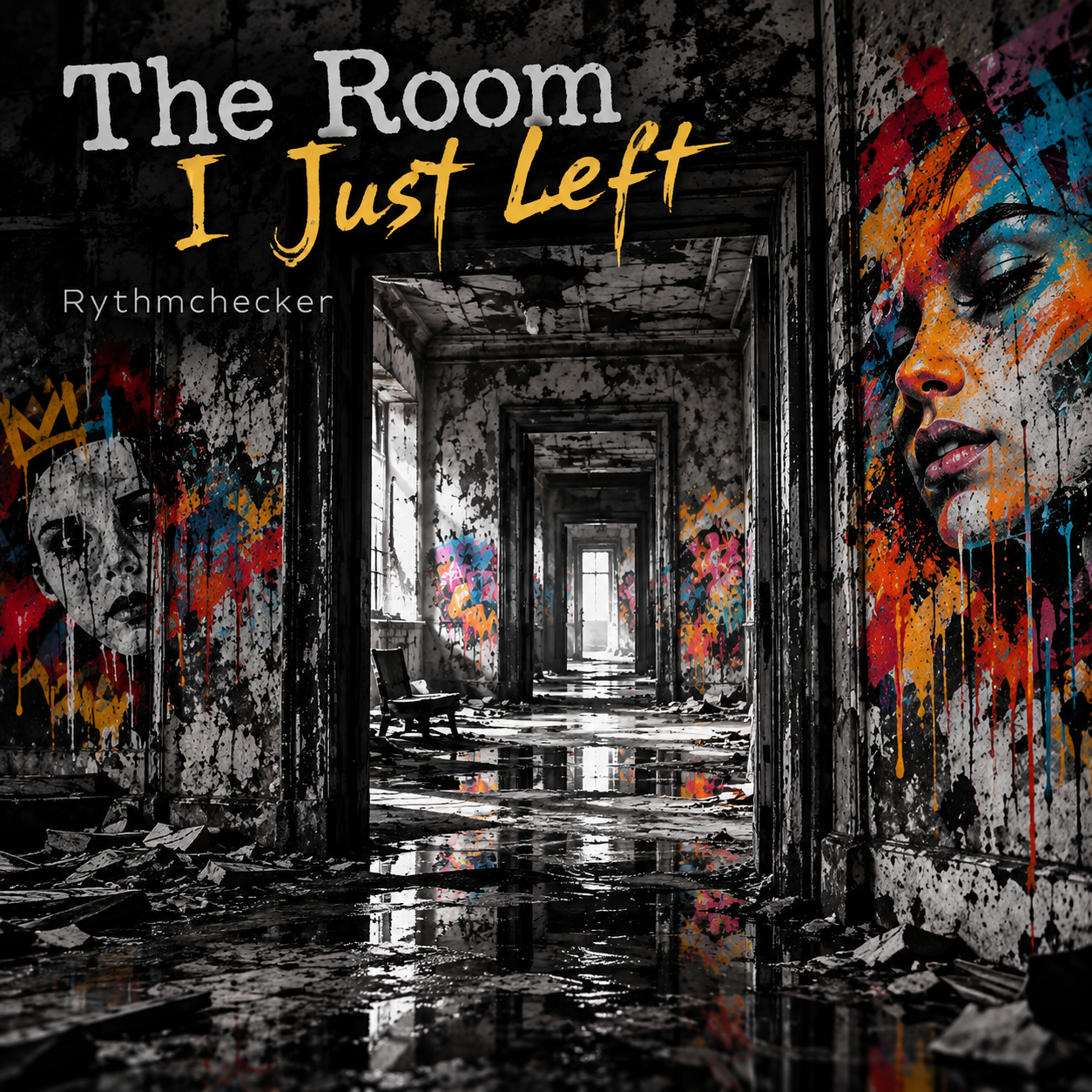
Als Nächstes: The Room I Just Left
The Room I Just Left ist als neuer Track von RythmChecker im News-Bereich angekündigt.
Ein langsamer Puls, sparse Piano-Momente und eine verlassene Architektur aus Schwarz, Weiß und Grautönen: Der Song führt die Promenade-Idee weiter, aber diesmal nicht durch ein Museum, sondern durch ein brüchiges Gebäude voller Spuren, Graffiti und Erinnerung.
Die komplette Songseite mit Artwork, Story und Lyrics ist jetzt online.
Zur Songseite
The Room I Just Left auf rythmchecker.de öffnen
Direkt streamen
Die komplette englische Story zum Song:
Complete Story
“The Room I Just Left” begins with a step. Then another. At first, there is almost nothing else. A slow pulse, sparse piano, a few sounds suspended in space and the feeling of someone walking without being in a hurry to arrive anywhere. The starting point for this idea goes back to something that had already inspired my earlier Rythmchecker song “Exhibition Tour”: the Promenade from Modest Mussorgsky’s “Pictures at an Exhibition”. In Mussorgsky’s work, the Promenade is more than music connecting one picture with the next. It represents movement through an exhibition. We follow a visitor walking, stopping, observing and continuing. The pictures change, but so does the person looking at them. I wanted to return to that idea, but not simply repeat “Exhibition Tour”. This time there is no gallery. There is no museum. There may not even be an exhibition. Instead, someone enters an abandoned building.
One step
Another
Stone under my feet
The building is close to collapse. The plaster has fallen from the walls. Windows are broken. Water has collected on the floor. Old doors hang crookedly from their hinges. Corridors lead into rooms whose original purpose has long been forgotten. Everything is almost monochrome. Black, white and endless shades of grey. There is only one exception. The graffiti. Red, orange, blue and yellow explode from the walls as if color itself has survived longer than the building. At first the walker simply observes.
A face
A room
A distant light
I stop
I look
There is no explanation of who this person is or why he has entered the building. I like that uncertainty. Perhaps he knows the place. Perhaps he has never been there before. Perhaps he is looking for something. Perhaps he is simply walking. The short vocal phrases are deliberately closer to observations than conventional storytelling. They arrive almost like individual photographs: a face, a room, a light. Then silence. Then another image. The piano fills the spaces that the words leave open. The connection to Mussorgsky’s Promenade becomes important here. The walking itself provides the structure. Each step takes us from one image to another, just as the Promenade once carried the visitor between pictures. But the pictures in “The Room I Just Left” do not hang in frames. They are painted directly onto damaged walls.
One frame
Another
Someone was here
Someone is gone
“Frame” therefore becomes ambiguous. It can be a picture frame. It can be a doorway. It can be a window. It can even be a single frame of memory. And everywhere there are traces of people who are no longer present. Graffiti is particularly fascinating to me in this context because it proves that someone was there without necessarily telling us who that person was. A name. A face. A symbol. A few words. Someone has left something behind. The person has disappeared, but the mark remains. Someone was here. Someone is gone. The walker continues.
Slowly
I walk
Slowly
They change
And this is the moment when the story begins to shift. At first we assume that “they” means the pictures. But then:
The eyes
The walls
The names
Something is wrong. A graffiti face he passed several rooms ago appears again. But not quite the same. Its eyes are looking in another direction. A name painted beneath it has changed. The walker turns around. The corridor behind him seems longer than before. Was there always another doorway there? He cannot remember. He continues. The song never turns this into horror. That distinction is important to me. There is no monster in the building. There is no sudden revelation. Nothing attacks him. Instead, reality becomes unreliable by tiny degrees. The building behaves increasingly like memory.
Rooms repeat themselves. Doorways seem familiar. A wall he remembers as empty now contains a huge colored face. Another face has disappeared completely. The architecture changes only when he is not looking directly at it. And because the changes are so small, neither he nor we can ever be certain that anything supernatural is happening. Perhaps the building is changing. Perhaps his memory of it is changing. Perhaps there is no difference between the two anymore. Then he sees a door.
A door
Half open
A shadow
Inside
For a moment, this seems as if it could finally provide an answer. Someone may be in there. The walker stops.
I stop
I look
But he does not enter.
I move on
That line is crucial to the story. The conventional reaction would be to investigate. To open the door. To find out what the shadow was. But “The Room I Just Left” is not about solving a mystery. It is about continuing through it. The long instrumental passage that follows becomes another kind of Promenade. There are no words because words are no longer necessary. The walker moves deeper into the building. Step by step. Room by room. Picture by picture. And slowly the abandoned building becomes an impossible exhibition. The graffiti are its paintings. The doorways are its frames. The corridors are its galleries. But there is no curator. No catalogue. No labels explaining what anything means. Only traces.
Picture by picture
Step by step
Something stays
Something fades
These lines contain the central idea of the song for me. They are not really about graffiti anymore. They are about memory. Some things remain astonishingly clear. A face. A room. A particular light. The sound of footsteps. Something somebody once said. Other things disappear. Names go first. Then details. Then chronology. Eventually we may remember an image without remembering where it belongs. That is why the building gradually becomes less a physical location and more a representation of memory itself. Memory is an abandoned exhibition that is constantly rebuilding itself. Some pictures remain on the walls. Others fade. Some move to different rooms. And occasionally we discover something that we are absolutely certain was not there before. The walker continues.
One step
Another
One step
Another
The repetition is almost ritualistic now. The Promenade has changed too. At the beginning it represented walking through a place. Now it represents persistence. As long as there is another step, the journey continues. Eventually the walker enters a room and stops. Something about it is familiar. The damaged wall. The broken window. The water on the floor. A particular piece of graffiti. Slowly he realizes: This is the room he just left. He turns around. But the doorway behind him is no longer there. There is only a wall. For the first time, he has no obvious way back. And yet the song does not become dramatic. There is another doorway ahead. Beyond it is light. He begins walking towards it. One step. Another. As he moves, the colored graffiti behind him slowly loses its color. Red becomes grey. Blue becomes grey. Yellow becomes grey. Faces disappear into concrete. Names become unreadable. Everything that once distinguished the pictures from the building gradually becomes part of the same monochrome surface. But the walker does not turn around.
Mmm…
Still walking.
Those final words are important because there is no real conclusion. We do not know whether he leaves the building. We do not know whether the doorway leads outside. We do not even know whether there is an outside anymore. He simply continues. And that is where “The Room I Just Left” ultimately separates itself from “Exhibition Tour”. Both songs share a conceptual ancestor in Mussorgsky’s “Pictures at an Exhibition” and especially its recurring Promenade. Both are built around the idea that looking at pictures and moving between them can itself become a narrative.
But they take different paths.
“Exhibition Tour” remains closer to the act of visiting and observing an exhibition.
“The Room I Just Left” takes the Promenade out of the museum and places it inside a decaying, impossible building.
The pictures have become graffiti.
The gallery has become a ruin.
The visitor has become lost somewhere between observer and participant.
And the Promenade is no longer merely the walk from one picture to another.
It becomes the act of moving through memory itself.
Perhaps that is also why the title only becomes completely meaningful at the end.
“The Room I Just Left” sounds like a precise description.
It suggests certainty.
I know which room I was in.
I know that I left it.
I know where I am now.
But by the end of the song, none of those statements can be trusted.
If the room ahead is the room behind, if the pictures change, if names disappear and walls move, then perhaps leaving a place does not mean that the place is behind us.
The same may be true of memories.
We leave moments, people, places and versions of ourselves behind every day.
Or at least we think we do.
Sometimes, years later, we open another door and discover the same room waiting for us.
Slightly changed.
A different picture on the wall.
A name we can no longer remember.
A face whose eyes seem to be looking somewhere else.
So we stop.
We look.
And eventually we do the only thing we can do.
One step.
Another.
Still walking.